What’s the difference between PL and SIL machine safety standards?
, , ,

 By 

Machine safety is governed by two standards: EN/ISO 13849-1 and EN/IEC 62061. Both standards are harmonized to the EU Machinery Directive 2006/42/EC, which defines the Essential Health and Safety Requirements (EHSR) for machinery. Although their methods for performing risk assessment are different, both standards — EN ISO 13849-1 and EN 62061 (SIL) — when correctly applied, achieve the same result.


The EU Machinery Directive requires that machine manufacturers eliminate or minimize hazards as much as reasonably possible, apply necessary protective measures against hazards that cannot be eliminated, and inform users of the risks that remain and requirements for training or personal protective equipment. Although this directive is specific to the European Union (EU), it is recognized and followed in other regions around the world to better facilitate equipment shipments outside the EU.


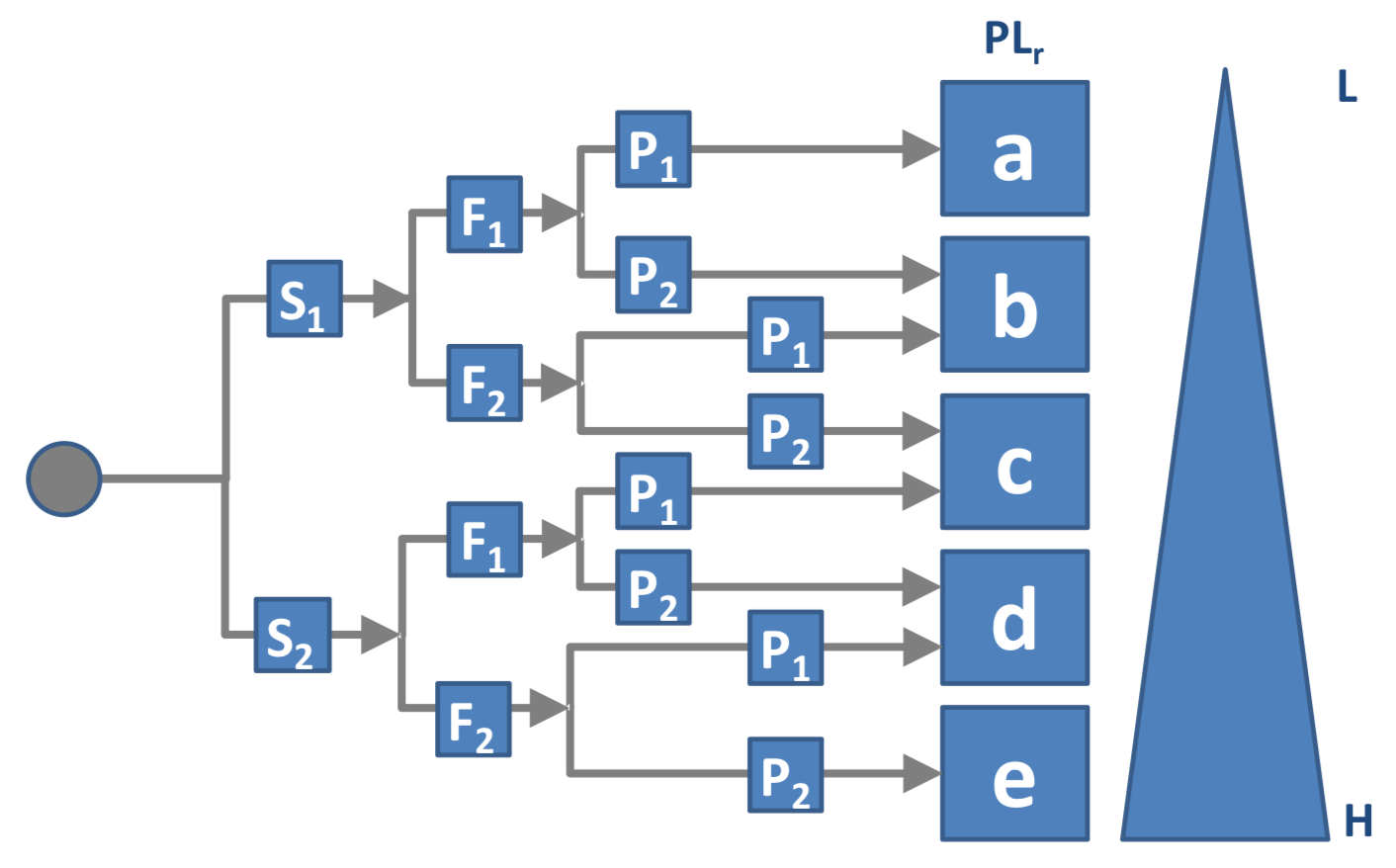
The EN/ISO 13849-1 machine safety standard uses a qualitative risk graph, or flow chart, to assign a performance level (PL), based on three criteria:

  • severity of injury
  • frequency and/or exposure time to the hazard
  • possibility of avoiding the hazard or limiting the harm

The performance level (PL) is designated by an alphabetic character, a through e, with PLe being the highest risk level.
machine safety standards
EN/ISO 13849-1 assigns a performance level (PL) rating from a to e, with PLe being the highest risk.
Image credit: TUV

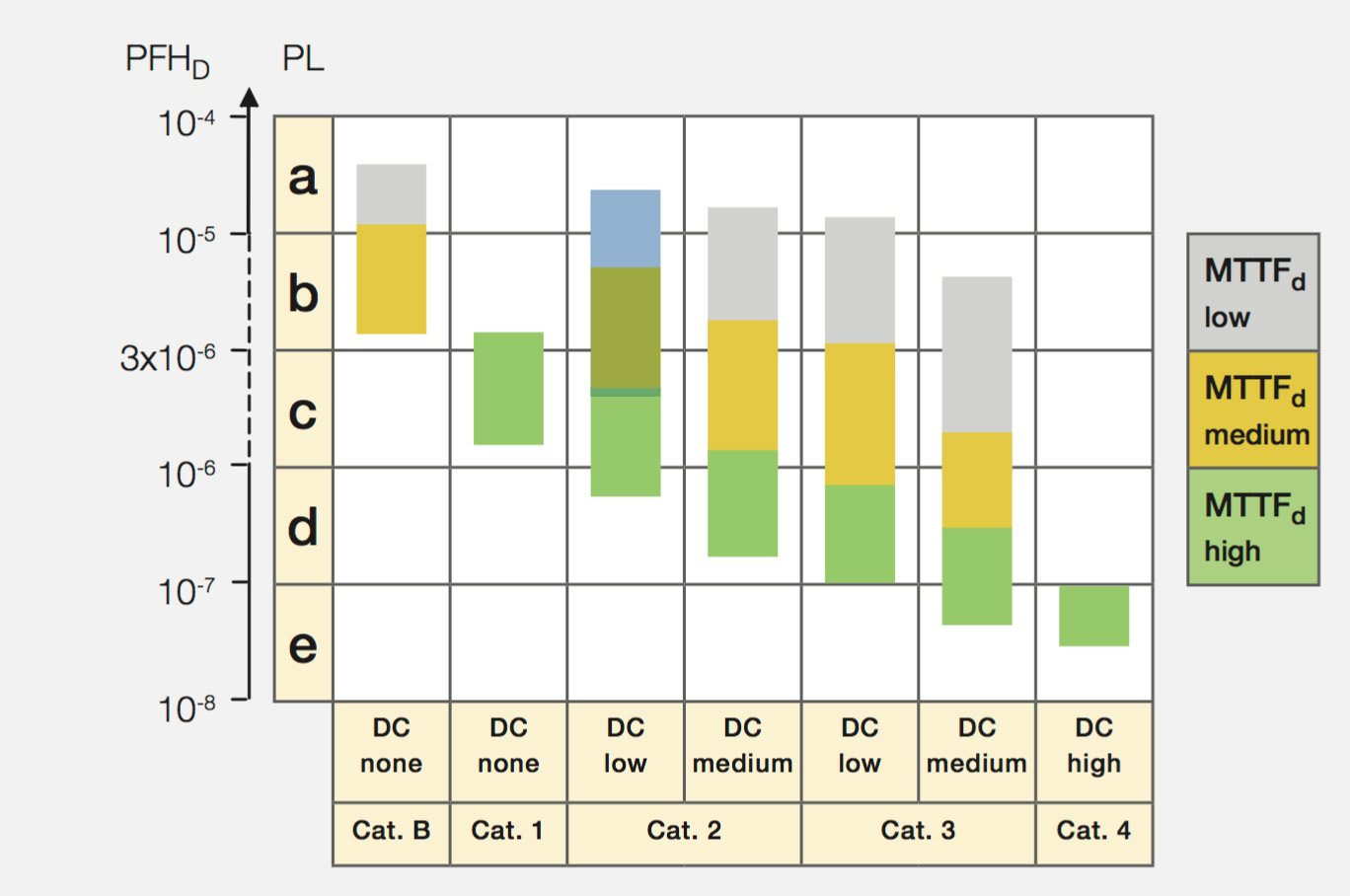
Once the performance level has been determined, the architecture that facilitates the defined performance level is classified into one of six categories (“B” and 1 through 5, with B being the least safe and 5 being the most safe). The architecture category is determined by combining the performance level (PL) with quantitative measures of diagnostic coverage (DC) and mean time to dangerous failure (MTTFd).
functional safety
This chart shows the relationship between Category, Diagnostic Coverage, and Mean Time to Dangerous Failure for PL levels under EN/ISO 13849-1. Note also the correlation with probability of dangerous failure per hour (PFHd) rates.
Image credit: ABB

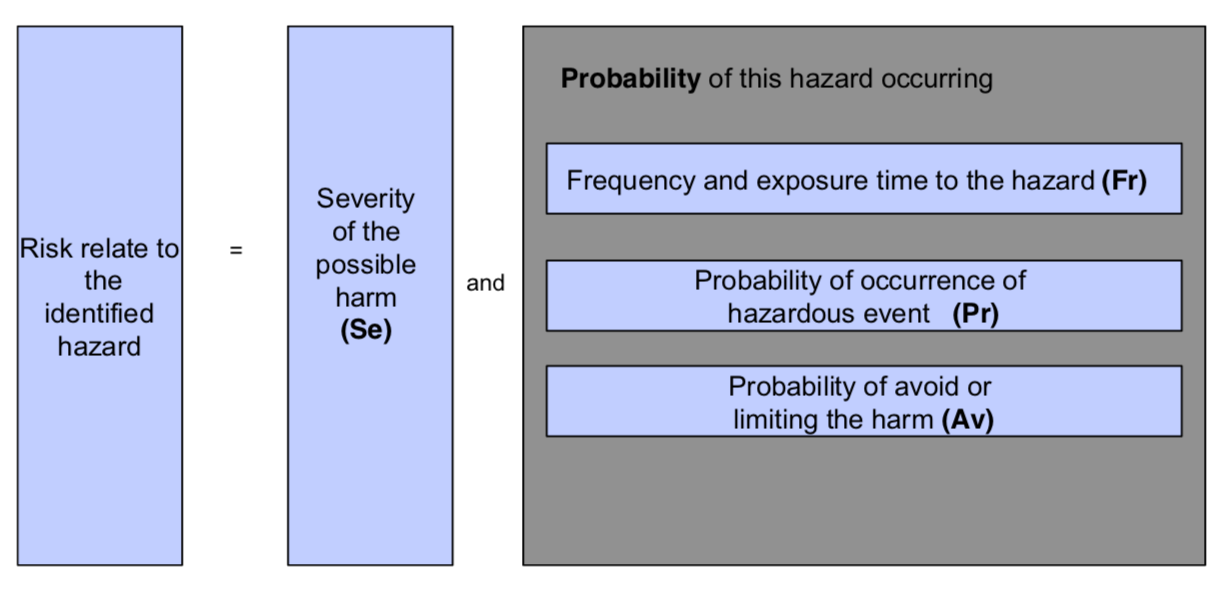
The EN/IEC 62061 machine safety standard (often written as just EN 62061) assigns a safety integrity level (SIL) to each function based on the severity of the potential harm (Se) and the probability of the harm occurring.

The severity of potential harm is given a score from 1 to 4, with 4 being the most severe. The probability of harm occurring is broken down into three parameters:

  • frequency and duration of exposure (Fr)
  • probability of an event occurring (Pr)
  • probability of avoiding or limiting the harm (Av)
machine safety standards
EN 62061 assigns a safety integrity level (SIL) from 1 to 3 based on the severity of potential harm and the probability of the harm occurring.
Image credit: TÜV

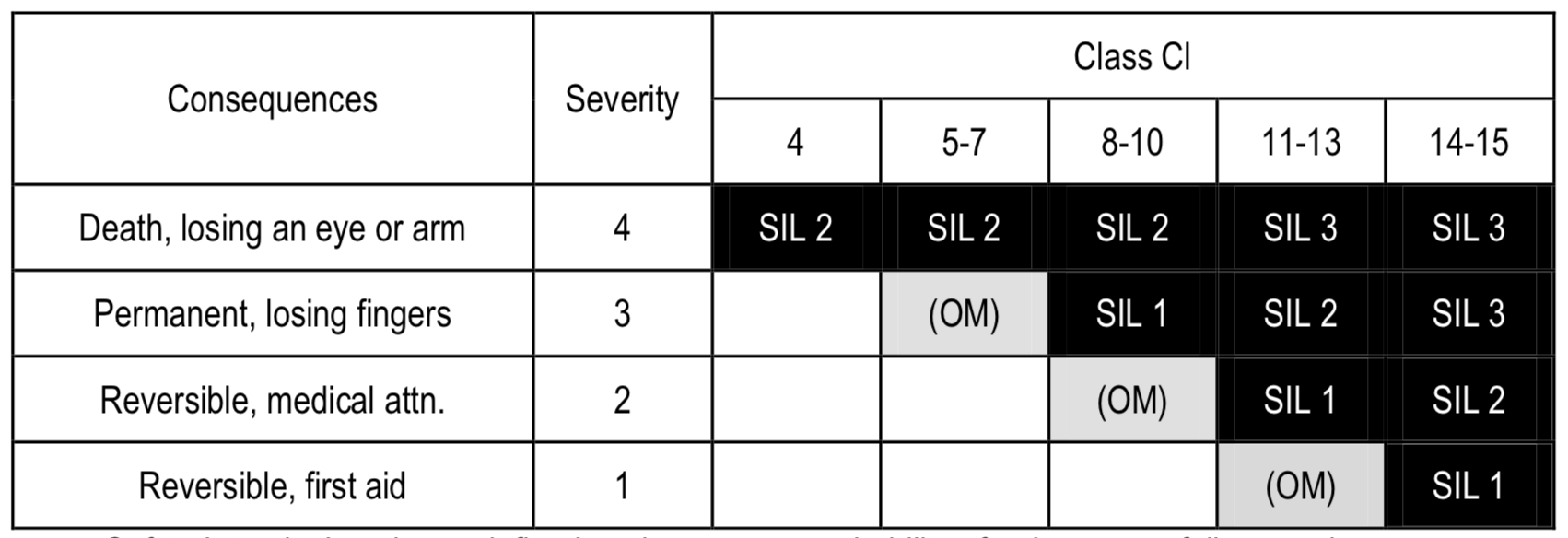
Each of these parameters is scored from 1 to 5, with 5 being the “worst,” or least safe situation, and their scores are summed to determine a class (Cl). The SIL rating is then chosen from a matrix that plots the severity scores (Se) and classes (Cl).
machine safety standards
SIL ratings are determined by a matrix that ranks the severity of injury and the injury classification.

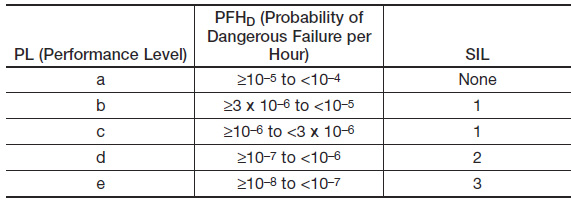
Once the safety integrity level (SIL) has been assigned, the system is broken into subsystems, whose architectures are classified as A, B, C, or D, with D being the “highest,” or safest. Each architecture is associated with a formula to determine the probability of dangerous failure per hour (PFHd) of the subsystem.
machine safety standards

Note that performance level (PL) ratings under EN/ISO 13849-1 are also correlated with probability of dangerous failures per hour (PFHd) values, so direct comparisons can be made between EN/ISO 13849-1 performance levels and EN 62061 safety integrity levels.


There is no strict guideline regarding the use of machine safety standards for particular applications, but the choice may be influenced by:

  • Prior experience with one standard or risk assessment methodology
  • The use of safety-related controls that are not based on electrical, electronic, or programmable electronic systems (use EN/ISO 13849-1)
  • A requirement to use SIL ratings to demonstrate safety integrity (use IEC 62061)
  • Use of equipment in process industries where other safety-related systems are characterized in terms of SIL (use IEC 62061)
Optimizing Job Site Performance with Intelligent Generator Control

Boosting productivity in today’s mobile‑equipment world depends on two things: efficiency and reliability. One of the most transformative improvements is the ability to start and stop generators powering mobile and rental equipment automatically. Smart generator control streamlines job site operations, reduces wasted runtime, and strengthens overall return on investment.

🔗 Reliable Communication Between Systems

Consistent communication between the controller and the generator is essential—especially for mechanically or electronically governed units. Any interruption can trigger downtime, slow productivity, and increase operating costs. Maintaining seamless interaction ensures stable power delivery and keeps equipment running at peak efficiency.

💪 Built for Harsh Environments

Generators rarely operate in gentle conditions. They face rain, snow, dust, and extreme temperatures. That means the control systems supporting them must be rugged enough to survive the same challenges. Durable construction and thoughtful engineering ensure reliable performance no matter what the environment throws at them.

⚙️ Smarter Controllers for OEMs

Integrating advanced controllers into mobile generators enables OEMs to monitor and manage performance from virtually anywhere. Key advantages include:

  • Precise Start/Stop Management — Automated control reduces unnecessary runtime and maximizes efficiency.
  • Fuel Optimization — Real‑time data helps adjust fuel usage, lowering operating costs.
  • Remote Diagnostics — Telemetry and monitoring tools detect issues early, preventing expensive failures and service interruptions.

📉 Reducing Downtime, Increasing Productivity

Real‑time adjustments and continuous monitoring ensure generators operate at their best. This reliability directly reduces equipment downtime and boosts job site productivity. With smarter control, power systems become more predictable, more efficient, and far easier to manage.

The Bottom Line

By combining robust communication, environment‑ready durability, and comprehensive remote monitoring, OEMs can dramatically improve generator performance and operational efficiency. These advancements don’t just enhance job site reliability—they create a meaningful competitive advantage in a demanding industrial landscape.


DynaGen™ PRO600

DynaGen™ TG410

DynaGen™ TG350

DynaGen™ Retro Kit


Messenger BLE

Messenger Lite

VisiTek™ 600

remoteIQ telemetry family
Concrete Line Pump Remote Controls
, , ,

Click here and Order your system now!

MUSCA 6F Concrete Pumping labelled System

These wireless remote control systems suit mobile, construction, and material handling equipment and, with IP65 to IP68 ratings, resist shock, impact, dust, moisture, and water.

Customers can personalize their transmitters with specific icons and symbols that match their equipment’s control interfaces, enhancing safety and ease of use.

Tyro 2S systems offer advanced features such as one-button pairing, thus allowing operators to quickly pair a new transmitter with the receiver, minimizing downtime. This is particularly beneficial in mobile applications where equipment may be frequently moved or lost.

Additionally, the systems support multiple transmitters per receiver and vice versa, providing multiple users with flexibility and redundancy in their operations.

The Tyro 2S systems also may have an LCD screen that displays real-time feedback from the connected equipment. This feature is particularly valuable in applications like concrete pumps, stone crushers, and other heavy machinery where monitoring parameters such as oil temperature, fuel level, and operational speeds are crucial.

The integration with CAN bus systems allows for seamless communication between the remote control and the machinery, enhancing operational efficiency and safety.

Explore our wireless remote control packages for concrete pumping and hoist remote control.

Tyro Pump Boss Musca Package includes the Musca 2S transmitter and Aquarius 2S receiver for concrete line pumping

Pump Boss™ Musca Package

Tyro Pump Boss Pyxis Package includes the Pyxis 2S transmitter and Aquarius 2S receiver for concrete line pumping

Pump Boss™ Pyxis Package

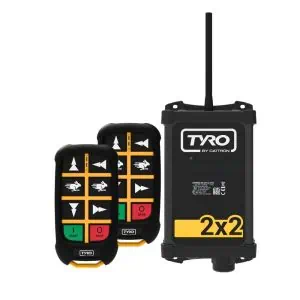
Tyro 2x2 package including two transmitters and one receiver

Tyro™ 2X2


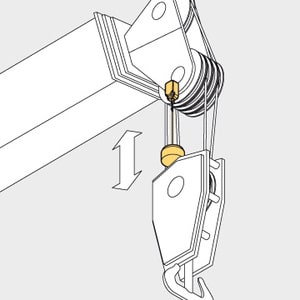
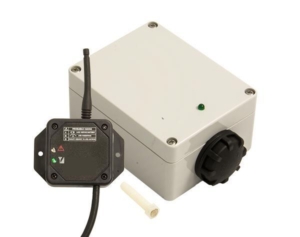
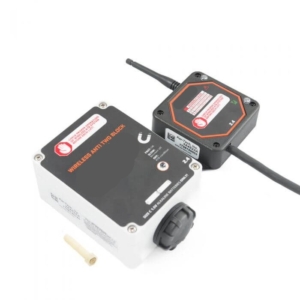
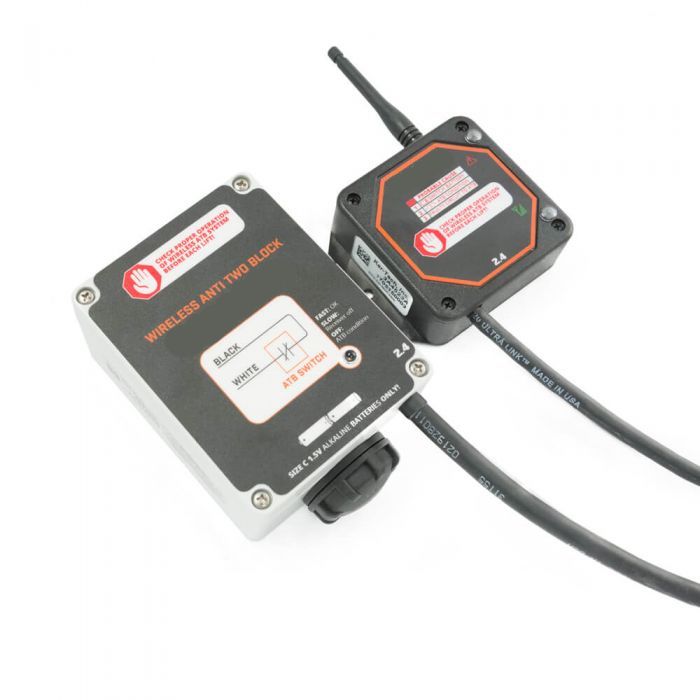
This Wireless ATB is designed to be a simple, cost-effective replacement for traditional ATB systems.

With a quick installation, it is an easy way to remove the headaches associated with the wires, rusted contacts, and loose springs of traditional ATB systems.

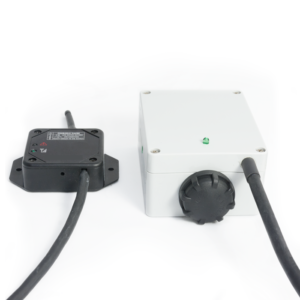
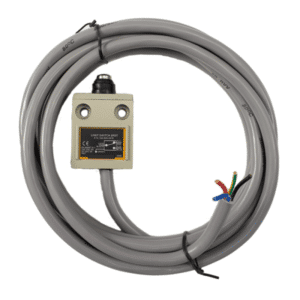
This wireless system eliminates both the cable reel and the Anti-Two-Block switch and the headaches associated with them. The self-contained switch is immune to mechanical failures and water damage since both the switch and the receiver are designed with solid-state components, which are fully encapsulated; the system is designed to be as hassle-free as possible. There’s no need to worry about the potential for a cable being broken by branches or other objects, and no need for a cable reel.

This is also a perfect solution to eliminate the corrosion factor in the reel contacts and their loose springs. Installation is as simple as mounting the wireless switch at the boom tip and installing the receiver at the base of the boom. This simple installation allows OEMs to reduce manufacturing costs by removing brackets, wire guides, and the associated labor.


Systems: 900MHz System | 2.4GHz System | Anti-Two Block Switch


Wireless Anti-Two Block System

Wireless 2.4GHz Anti-Two Block Switch Transmitter System


“Elevated shock and vibration levels, even violently spraying hydraulic fluid during testing are no match for this rugged, mobile data acquisition system.”

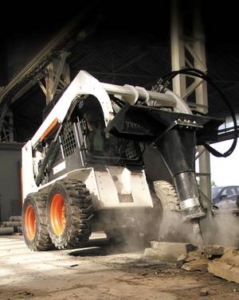
Mike Ellis, a Project Engineer with Gates Corporation (currently with Anderson Controls), the United States Customer Solutions Center focusing on Advanced Product Technology, and his team were recently in the field collecting hydraulic pressure and acceleration data. Their aim was to try to replicate and capture event data using HBM’s SoMat eDAQ, a rugged, mobile data acquisition system, in hopes of discovering the cause of customer failures on a skid steer loader’s rock breaker attachment.

During testing, elevated shock and vibration levels shook the eDAQ and skid steer, and excessive dust from the rock breaker covered everything. After several hours of operating in the harshest of duty cycles, the failure occurred, violently spraying hydraulic fluid around the entire machine for about 10 seconds. After it was contained, Ellis’ team inspected the damage. The eDAQ was covered in hydraulic fluid from top to bottom—soaked in approximately 6.35mm of fluid. Ellis remarked, “My colleague who operated the skid steer at the time of the failure was concerned the system was destroyed, or, worse yet, the data lost. I assured him that was not an issue. We wiped down the eDAQ downloaded the data from the test run and continued to test the remainder of the day.”

Recalling this incident and the operation of the eDAQ, Ellis confidently stated: “Our eDAQ system is by far the most rugged piece of testing equipment we own. If my laptop or our other test equipment had been in the skid steer, they certainly would not have survived.”

The rugged and dependable capabilities of the eDAQ were observed by Ellis even before the Gates Corporation purchased their existing systems. He was thoroughly impressed with the eDAQ’s use at many of his customers’ locations. The eDAQ has proven itself in Gates Corporation’s laboratories as well as the field. Ellis adds, “It is an extremely accurate system. It is so easy to use; we use it as a check on our other pieces of laboratory testing equipment—to make sure they are set up correctly. If I do have a question, I know the SoMat brand is backed by a true engineering firm. In working with their support team, I can always call and ‘talk application’ not just to see if ‘a certain transistor is bad.’ Furthermore, the updates for the SoMat software are great. They are always backward compatible and, unlike our other lab equipment, there are no hidden or upgrade fees. I know that I can depend on our investment being supported for many years to come.”