IP Ratings for Industrial Remote Control Systems

IP is an acronym for Ingress Protection and is a standard set by the International Electrotechnical Commission (IEC) 60529 to classify the degree of protection by an electronic device against the intrusion of foreign objects such as dust and water. An IP rating consists of two numbers, each representing a different aspect of protection.

  • The first number refers to the level of protection against solid objects such as dust.
  • The second number relates to the degree of protection against liquids.


This article explains the different IP ratings focusing on water ingress.

IP65 Rating

An IP65 rating means the product is protected against dust and low-pressure water jets from any direction.

  • (6) indicates that the product has high protection against dust, making it nearly completely dust-tight.
  • (5) – shows the product is protected against low-pressure water jets from any direction, meaning it can withstand moderate water exposure without damage.

A product with an IP65 rating is ideal for outdoor use, as it is protected from dust and water. The product is durable and can withstand harsh environmental conditions, making it a reliable choice for various industries such as construction, manufacturing, and outdoor environments.

If you are looking for a product that can withstand tough conditions and provide efficient performance in dusty or wet environments, choosing one with an IP65 rating is a wise choice.

IP66 Rating

An IP66 rating means the product is protected against dust and high-pressure water jets from any direction.

  • (6) – indicates a high level of protection against dust, making it nearly completely dust-tight.
  • (6) – signifies that the product can withstand powerful water jets without damage.

This makes an IP66-rated product suitable for use in harsh outdoor environments where there may be exposure to heavy rain or strong water sprays. Products with this rating are commonly used in industries such as marine, agriculture, and food processing, where there is a need for durable and waterproof equipment.

If you require a product that can withstand dust and strong water jets, opting for one with an IP66 rating will provide you with the necessary protection and performance.

IP67 Rating

An IP67 rating means the product is completely protected against dust and can withstand immersion in water up to one meter for a limited time.

  • (6) – indicates a high level of protection against dust, making it nearly completely dust-tight.
  • (7) – shows that the product can withstand temporary submersion in water without any damage.

This level of protection makes the product suitable for outdoor use, including marine and industrial environments where it may be exposed to significant dust exposure or water submersion. Products with an IP67 rating are commonly used in the automotive industry as they can withstand high-pressure water jets during car washes or heavy rain while driving. The rating ensures the product is durable and reliable in harsh conditions, making it a preferred choice for various applications where dust and water resistance are essential.

If you need a product that can withstand extreme conditions without compromising performance, choosing one with an IP67 rating is a smart decision.

IP68 Rating

An IP68 rating means the product is fully protected against dust and can withstand continuous immersion in water under specified conditions.

  • (6) – indicates a high level of protection against dust, making it nearly completely dust-tight.
  • (8) – signifies that the product can withstand prolonged submersion in water without any damage.

This makes an IP68 rating suitable for extreme outdoor environments such as construction sites or underwater applications. Products with an IP68 rating are commonly used in the electronics industry to ensure that electronic components are well-protected from dust and water ingress. With this level of protection, you can trust that your product will continue to function even when exposed to harsh environmental conditions.

If you need a product that can withstand complete dust and water immersion without compromising performance, opting for one with an IP68 rating is the way to go.
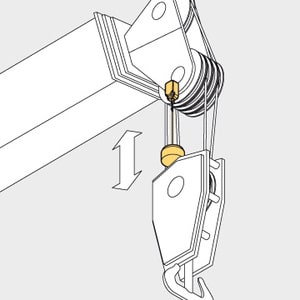
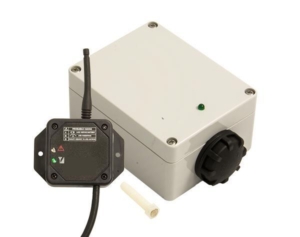
 

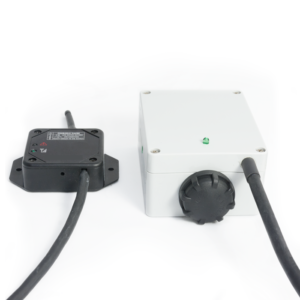
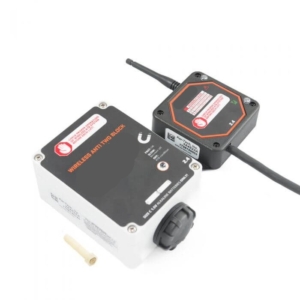
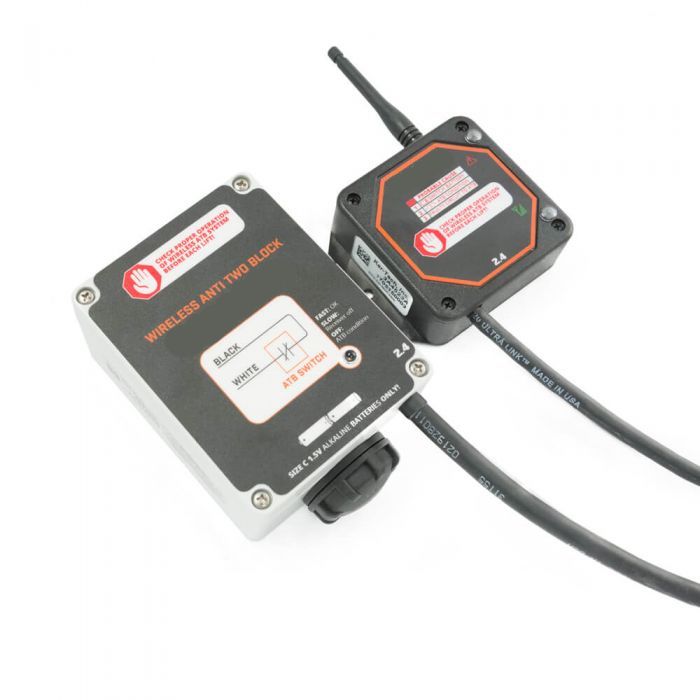
This Wireless ATB is designed to be a simple, cost-effective replacement for traditional ATB systems.

With a quick installation, it is an easy way to remove the headaches associated with the wires, rusted contacts, and loose springs of traditional ATB systems.

This wireless system eliminates both the cable reel and the Anti-Two-Block switch and the headaches associated with them. The self-contained switch is immune to mechanical failures and water damage since both the switch and the receiver are designed with solid-state components, which are fully encapsulated; the system is designed to be as hassle-free as possible. There’s no need to worry about the potential for a cable being broken by branches or other objects, and no need for a cable reel.

This is also a perfect solution to eliminate the corrosion factor in the reel contacts and their loose springs. Installation is as simple as mounting the wireless switch at the boom tip and installing the receiver at the base of the boom. This simple installation allows OEMs to reduce manufacturing costs by removing brackets, wire guides, and the associated labor.


Systems: 900MHz System | 2.4GHz System | Anti-Two Block Switch


Wireless Anti-Two Block System

Wireless 2.4GHz Anti-Two Block Switch Transmitter System


Dependable electronics are an absolute necessity in hazardous environments. However, the combination of combustible gases or dust with an arc or a spark from these products can potentially cause devastating fires or explosions. Whether you are at the chemical plant, on your oil platform or offshore drilling rig, in your mill, or somewhere equally as dangerous, all of your equipment is likely carrying a hazardous rating like Class I Div 2, Class I Div 1, IECEx/ATEX Zone 1 or Zone 2. But what does that mean exactly and how does this affect what lighting you should buy? Read on for more clarity on hazardous environments and ratings.

What is a hazardous location?

Hazardous locations are in more places than you think and it’s important to be aware of them if you are purchasing electronic equipment including LED lighting. Even your local gas/petrol station is considered a hazardous location because of the potential for an explosion. If, for example, a spark or lit cigarette collides with a drop or puddle of gasoline – FIRE! Your gas station needs hazardous-rated lighting.

According to UL (a US-based global certification laboratory), a hazardous location is “where explosion or fire hazards exist due to the presence of flammable gases, flammable or combustible liquid-produced vapors, combustible dust, or ignitable fibers or flyings.”

This could mean anything from the obvious like a drilling rig or chemical plant where highly flammable substances are mined or processed. Or it could mean the less obvious like a mill or sugar processing facility where the minute particles in the air have the potential to create a spark in the right conditions. Each facility is rated differently, based on their potential for explosion, which we’ll dive deeper into below.

What are some of the hazardous UL Ratings?

UL ratings are seen and adhered to most often in North America but do apply to countries in South America, Asia, and the Middle East. When looking at a hazardous UL rating, you’ll find the Class first and then the Division.

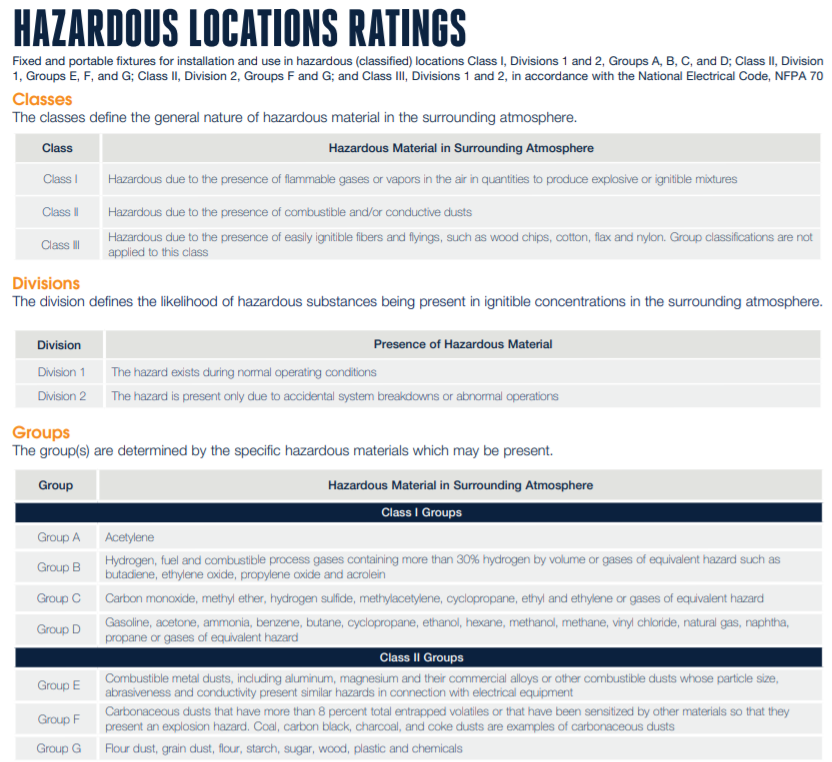
Dialight most often sees and certifies Class I, II, and III. The main difference between the three is the presence of flammable gases/vapors; combustible or conductive dust; or fibers like wood chips and cotton (see the chart below). The lower the Class the higher the hazard.

The Division (1 or 2) is what defines the likelihood of there being hazardous substances in enough ignitable concentrations in the atmosphere (i.e. what is the likelihood that there is enough gas or dust in a given situation that it would ignite or explode and what is the circumstance for that). If your facility is Div 1, it means that the particles or gases/vapors created at your facility are always potentially going to ignite and severe caution is needed to prevent a spark (think chemical processing). Div 2 means that an explosion or fire could only happen in the event of some breakdown or system failure but that extreme caution should still be observed to prevent catastrophe (ex. A platform in an oil refinery may be a CI D2 environment as the decks tend to be outdoors and far enough away from the source of the flammable gas. It would only become hazardous if an abnormal condition occurred like a valve failure or similar accident.)

UL_Haz_Doc

What are some hazardous ATEX Ratings?

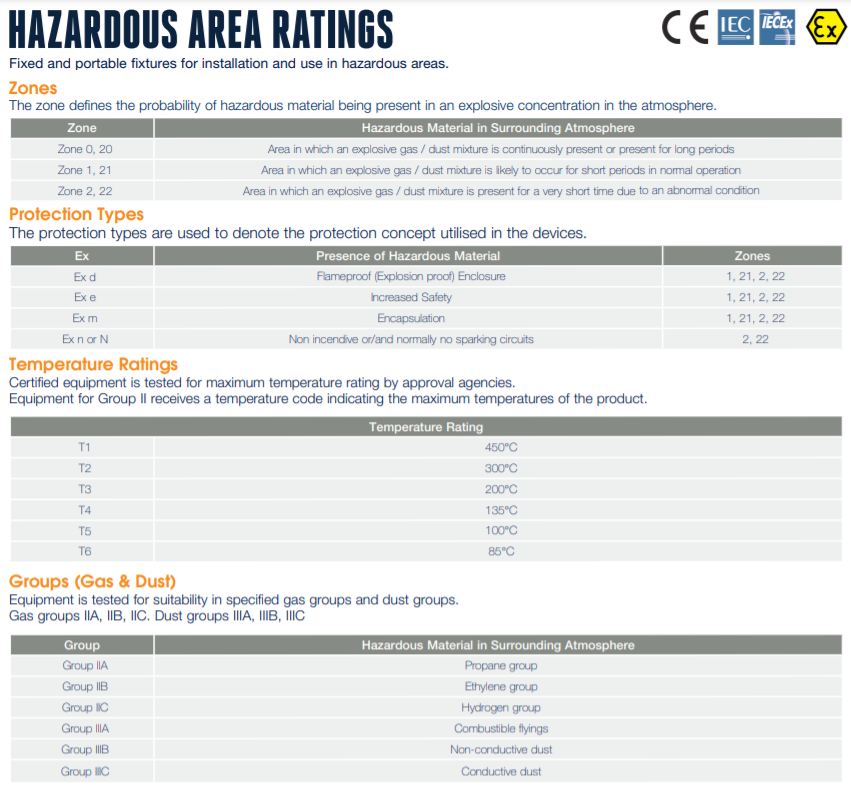
IECEx/ATEX ratings are seen most often in Europe, Australia, and parts of Africa, Asia, and the Middle East. They are relatively similar to UL ratings in that the lower the Zone the higher the probability is for fire or explosion based on the materials present and their concentration in the atmosphere. Both UL and ATEX classify certain substances in groups. Check out our ATEX reference chart below.

Atex_Doc